Papers We Love NYC | Learning Rules: What can math tell us about language
Hosted by Papers We Love - NYC + Emmy Briggs + Sahar Mor (Bond AI) + Alex Kouzemtchenko + Jennifer Bodie + SK + Abed Qaddoumi + John Feminella
View organizer listing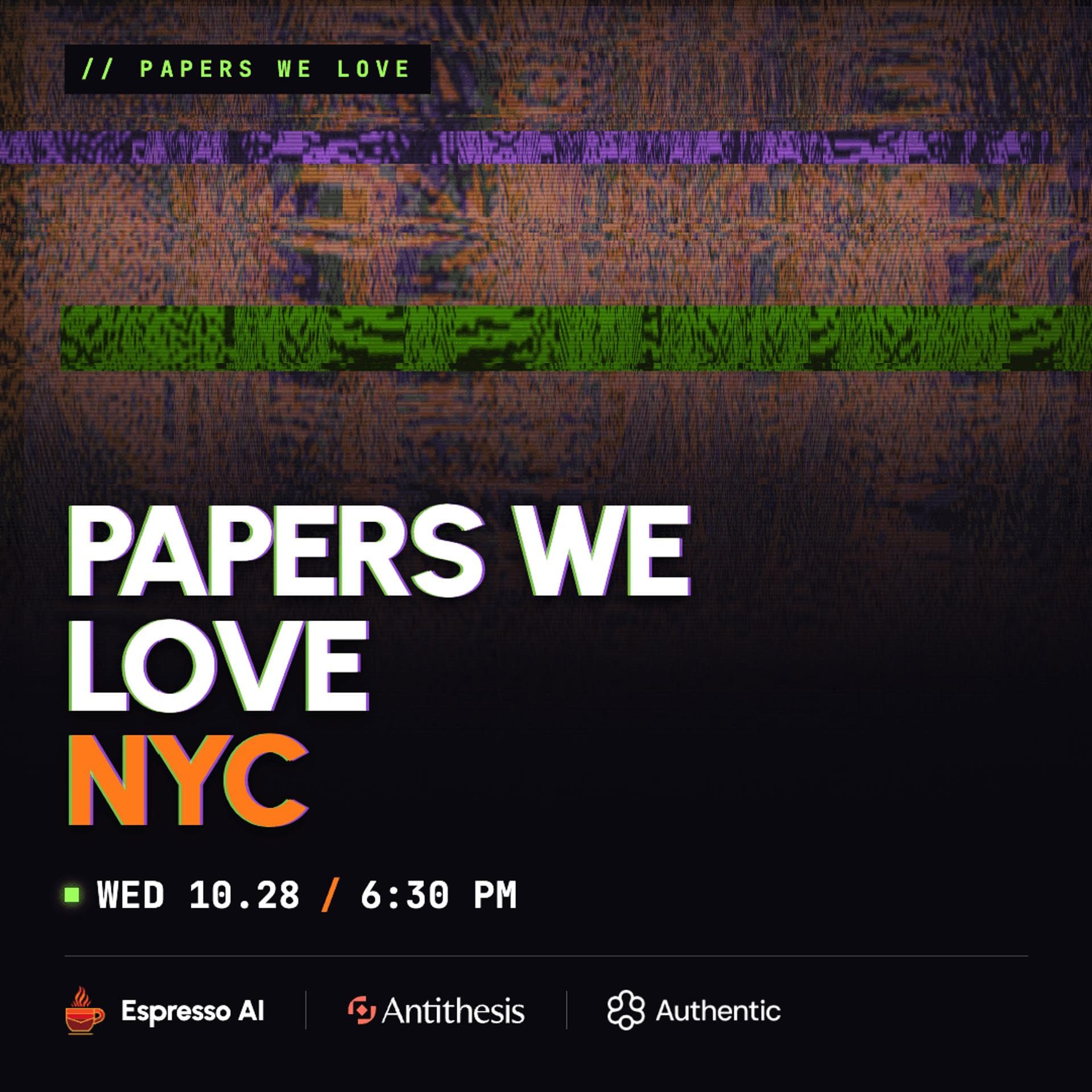
This event has ended. These details are kept for reference.
What to look forward to
October’s Papers We Love will explore what mathematical learning theory can reveal about language, centering on Gold’s 1967 paper on language identification and a 2024 supporting paper on language generation. Speaker Abed Qaddoumi, a Linguistics PhD student affiliated with Stony Brook’s Institute for Advanced Computational Science and an NYU computer science MS graduate, will connect the research to computational models of language, including Arabic phonology and morphology.
Inside the event
Papers We Love, Espresso AI, Authentic and Antithesis are pleased to present the October edition of PwL.
Papers We Love is a community of programmers who love reading and discussing computer science papers.
What was the last paper within the realm of computing you read and loved? What did it inspire you to build or tinker with? Come share the ideas in an awesome academic or research paper with fellow engineers, programmers, and paper-readers. Lead a session and show off code you wrote that implements these ideas, or just give us the lowdown on the paper. Otherwise, just come, listen, learn, and discuss.
Speaker: Abed Qaddoumi
More about Abed: Abed Qaddoumi is a PhD student in Linguistics at Stony Brook University, affiliated with the Institute for Advanced Computational Science. His research sits at the intersection of computation, language, and cognition: how computers can learn and represent the patterns underlying human language, drawing on grammatical inference, formal-language theory, and neural networks. He focuses on modeling phonological and morphological patterns, particularly in Arabic, using finite-state machines to represent permissible sequences of sounds and morphemes, analyze their formal properties, and study how these patterns can be learned from examples. Before Stony Brook, Abed earned an MS in Computer Science from NYU and worked on climate modeling at a finance startup. In a previous life, he worked for Doctors Without Borders and scooped ice cream at Ben & Jerry's. More at [abdulrahimq.github.io and Google Scholar.
Paper: https://www.sciencedirect.com/science/article/pii/S0019995867911655
Title: Learning Rules: What can math tell us about language?
Main Paper: Gold, Language Identification in the Limit (1967)
Supporting Papers: Kleinberg & Mullainathan, Language Generation in the Limit (2024)
Outline: Algebra can explain some social structures. The Cashinahua kinship relationships mirror the symmetries of a square. Can we discover similar mathematical structures in human language? This talk shows that some sound patterns can be described using algebra, logic, automata, and formal languages.
The talk follows three questions
- What structure does language have? Starting with social relationships, we connect algebraic structures to automata and formal languages, then look at examples from phonology. Along the way, we'll see how regular and subregular descriptions help specify what information a linguistic pattern requires.
- Can humans learn language rules from examples? We'll review Gold's 1967 paper, which formalizes the question. A learner receives examples and makes successive guesses, eventually settling on a correct grammar. Gold's negative result shows that no learner can guarantee this for the entire class of regular languages from arbitrary positive presentations alone. We'll see why, then explain how restrictions on the hypothesis space and changes in the available evidence can make learning possible.
- Must we identify a language to generate from it? Kleinberg and Mullainathan changed the task. Instead of identifying valid strings, the learner has to produce valid strings that have not appeared in the input. In their formal setting, generation can succeed even for language families where identification cannot. We'll examine what this means for the success of language models, and when a model produces valid new language, what we can say about the linguistic structure it has learned.
6:30pm - Doors
7:00pm - Speaker begins
PwL curate a repository of papers and places to find them. Contributions welcome via PR.
Join the PWL Discord and hop into the #nyc channel: https://discord.gg/B7aHhwBb8r
Papers We Love has a Code of Conduct. Be good to each other and to the PWL community.
Mindspace Williamsburg
Mindspace Williamsburg, 25 Kent Ave lobby; Suite 401, Brooklyn, NY 11249, USA. Confirm the venue with the organizer before traveling.
Open in Google Maps ↗Discovered through Cerebral Valley. Details come from the event listing and the organizer page; registration is managed by the organizer.
Last checked: Nov 3, 2026. Confirm current availability before making plans.
Organizer page checked: Oct 27, 2026. Check registration for the latest details.