× MIT Hack Day: Peptides
Hosted by Ascension - by AGI House SF + Julius Ritter + Serge Alexander Didenko + Micah Stubbs
Register with organizer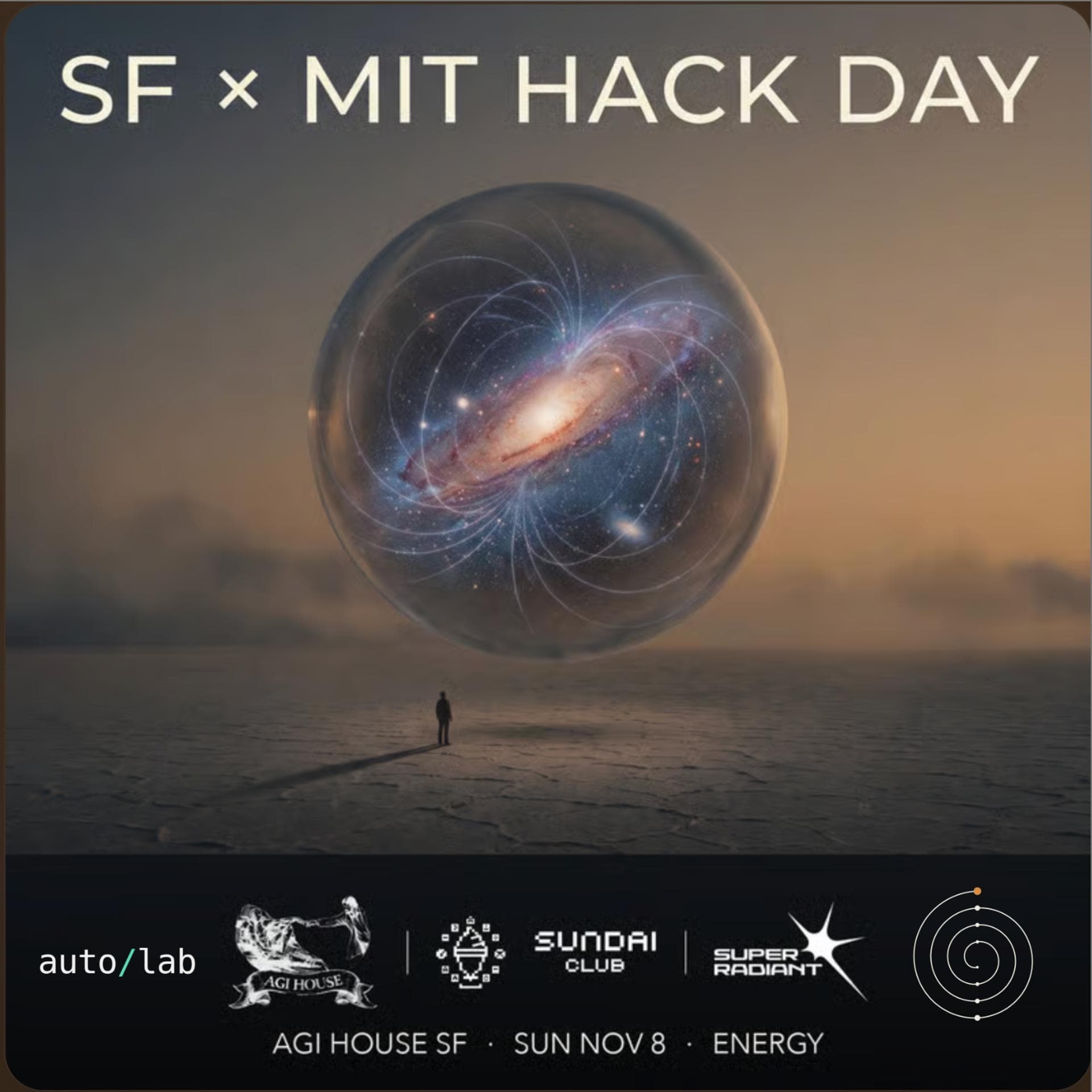
What to look forward to
The second SF × MIT hack day will focus on building agents for peptide design, human-evidence research, and scientific evaluation, helping models predict which candidates may bind targets, remain stable, and be safe. It will be organized by Superradiant founders Micah Stubbs and Alejandro Zarzuelo Urdiales, alongside communities and teams with track records including 130+ hackathons and work on autonomous learning and scientific agents.
Inside the event
Round two of the SF × MIT hack days, this time on peptides. Sundai Club builds at MIT, we build at AGI House SF.
The hack: agents that audit the evidence behind a peptide.
Peptides are short chains of amino acids. GLP-1 drugs like semaglutide are peptides. So are the compounds sold online as research chemicals. BPC-157, the most popular of them, has more than 500 animal studies and three human ones, and almost all of the animal work comes from a single lab in Zagreb. Establishing that for one compound takes a few hours of reading. There are about twenty compounds in common use and nobody has done it for them.
Tools we'll use: Claude Code for pipelines, Edison Scientific Kosmos for literature loops, Autolab.ai for running model and prompt grids against the gold set.
Datasets and APIs: PubMed, Europe PMC, ClinicalTrials.gov, openFDA and the FDA bulk substance lists, all public APIs. Measured datasets with hidden answers for the prediction track. Starter repos with the APIs wired and a gold set to score against.
Tracks
- Evidence graph - agents that take a compound and return every paper behind it, how many independent groups produced them, which were animal and which were human, how many subjects, what dose, what route. One card per compound, every number linked to its source.
- Claim to source - agents that take a claim as it is actually written on a forum or a vendor page and come back with the primary document, or with nothing, which is frequently the correct answer.
- Safety record - agents that pull adverse event reports and case reports for compounds that were never approved, and say what has actually been reported rather than what people assume.
- Prediction checks - graders that tell you whether a model can predict a measured property, such as red blood cell lysis, permeability or stability, on sequences it has never seen, so you know whether a model's opinion about a peptide is worth anything.
Schedule
- 10:00 - doors, coffee, intro
- 10:30 - team formation
- 1:00 - lunch
- 6:30 - demos
- 7:30 - done
Spots are limited and we approve applications on a rolling basis.
Who's behind it
AGI House SF is a hacker house on St. Germain Ave where researchers and founders meet to build on the frontier. We run hackathons, salons and dinners most weeks.
Sundai.club is the largest AI hacker community born out of Harvard and MIT, with more than 130 hackathons shipped back-to-back over the last 2.5 years — one every Sunday without stopping. 1000+ projects, many funded by VCs, YC and others.
RSIhouse.ai is a weekly open neutral space for hacks and dinners dedicated to recursive self-improvement. We cover post-training, evals, harness engineering, self-play and swarm intelligence. Every week we explore the limits of RSI.
Autolab.ai is building infrastructure for RSI. Starting with evals, Autolab enables fully autonomous continual learning and ownership of your own enterprise AI models that get better with every API call you make.
Superradiant is a research lab building self-improving agents, bringing the rapid advances in mathematics to the sciences. The name comes from superradiance, the quantum effect where emitters that fall into phase radiate together and the light grows with N² instead of N. Their founders, Micah Stubbs and Alejandro Zarzuelo Urdiales, put this series together.
San Francisco, CA
Venue listed by the organizer · San Francisco, CA. Confirm the final address before traveling.
Open in Google Maps ↗Details come from the event listing and the organizer page; registration is managed by the organizer.
Last checked: Nov 24, 2026. Confirm current availability before making plans.
Organizer page checked: Nov 24, 2026. Check registration for the latest details.