AI4Science - The Next Chapter for Science
Hosted by Merantix AI Campus + Nasim Rahaman
Register with organizer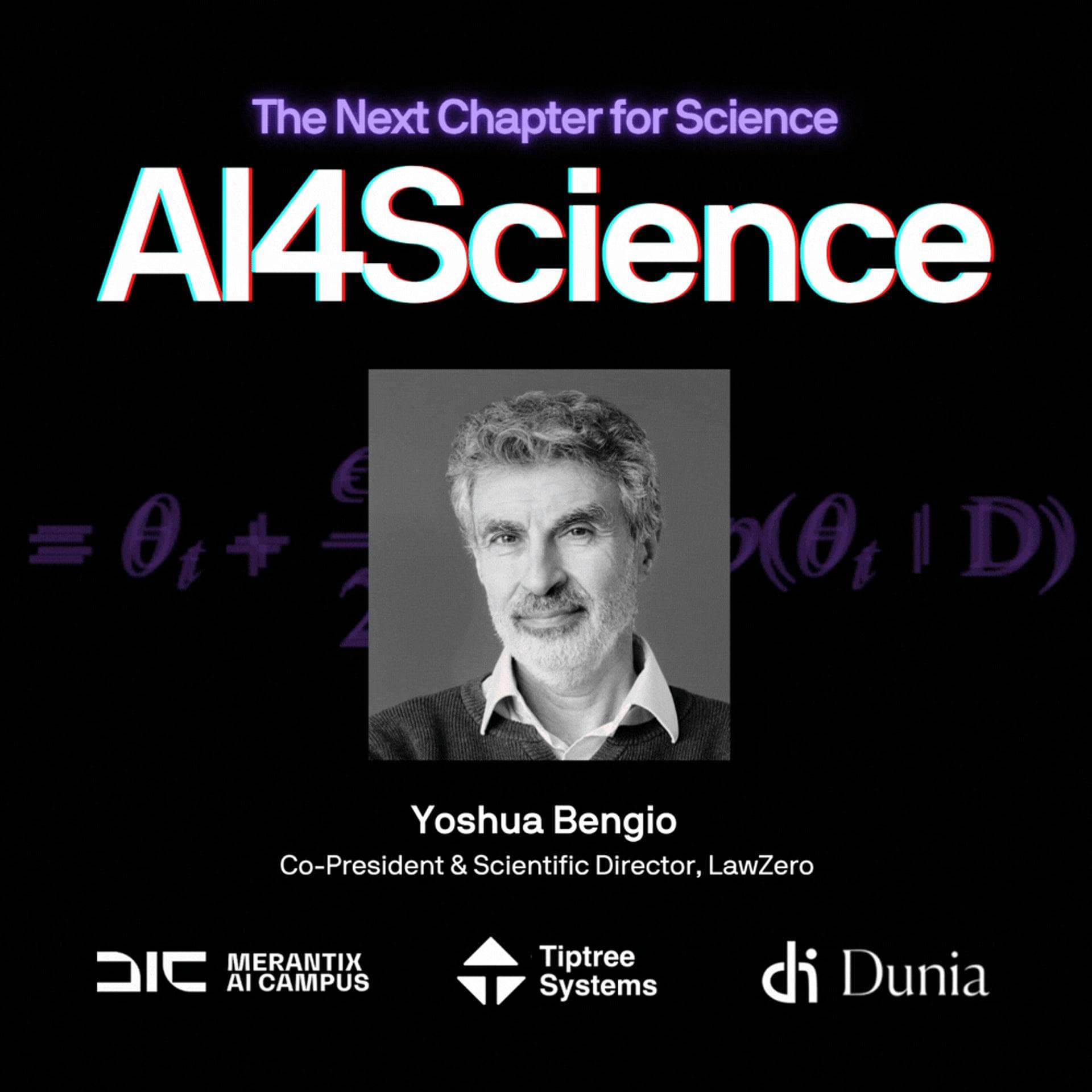
What to look forward to
This AI4Science evening will examine how generative and foundation models, simulations, and experiments can form tighter scientific discovery loops, and why benchmark gains don’t always translate to lab results. Talks will feature ML researchers, applied scientists, and engineers, including Patrik Reizinger, a causality and generalization researcher with a PhD from MPI-IS and ELLIS Tübingen.
Inside the event
The year is 2026. AI drafts hypotheses, runs simulations and proposes candidate molecules faster than any scientist can check them. So what does a scientist do all day now?
Where do new ideas come from? Will AI widen what we imagine, or pull everyone toward the same safe answers? What counts as understanding when a model can predict what no one can explain? And as AI grows more capable and more autonomous, how do we keep it working toward what science is for: understanding, shared openly, in service of people?
By 2036, “AI for science” may simply be called science. Whether that science is good, safe, and trustworthy depends on the work being done today.
This AI4Science evening brings together some of the researchers doing it, as the international science community gathers for Berlin Science Week. Our panelists take on the questions above from different corners of the field:
🎤 Yoshua Bengio
Co-President & Scientific Director, LawZero
Turing Award recipient (2018) for foundational work in deep learning, founder of Mila, and the most-cited computer scientist worldwide. Since 2023 he has focused on AI safety, and in 2025 he launched LawZero, a nonprofit building Scientist AI, an approach to highly capable AI that is safe by design. He also chairs the International AI Safety Report and holds a Canada CIFAR AI Chair.
🎤 Lyad Rahwan
Director, Max Planck Institute for Human Development; Founder, Center for Humans and Machines
Studies how AI changes the way people think, learn, work, cooperate, and govern. He helped establish the field of machine behaviour, which studies AI systems as actors with behavioural patterns of their own, and led the Moral Machine experiment, which gathered tens of millions of decisions from people worldwide on the ethics of autonomous vehicles. Before moving to Berlin, he led the Scalable Cooperation group at the MIT Media Lab. He is also an honorary professor at TU Berlin.
🎤 Patrik Reizinger
IVADO Postdoctoral Fellow, Mila / Université de Montréal
Works on causal representation learning and on when and why models generalize, including out-of-distribution and compositional generalization. His research has taken him from a PhD in Tübingen through Cambridge and the Vector Institute to Mila. As a BiTS × SPRIND fellow, he is building automatic, graded verification for scientific claims, so that AI-assisted research can build on what is already well supported. He also writes about scientific taste, the skill of telling great ideas from bad ones, and why it matters more once AI does the producing.
🎤 Vincent Stimper
Senior Research Scientist, Isomorphic Labs
Builds machine learning methods for the natural sciences at Alphabet’s AI drug-discovery company. He studied physics at TU Munich and completed his PhD at Cambridge and MPI-IS Tübingen, developing generative models of the shapes molecules can take. He is also the lead developer of widely used open-source implementations of these models.
🎤 Alexander Hammer
Co-founder & CEO, Dunia Innovations
After working in industrial R&D at BASF and Siemens, Alex did his PhD at the University of Glasgow with Lee Cronin, contributing to chemputation, the approach of turning chemistry into code that robots can run. In 2022 he co-founded Dunia to close the gap between what AI predicts and what actually works in the lab. Dunia’s self-driving lab, IRIS, couples AI with autonomous robotic experimentation to design, make and test new materials for catalysis, energy storage and semiconductors. In 2026 the company announced plans for a Berlin GigaLab to do this at industrial scale. He argues that the bottleneck in AI for science is not necessarily compute but rather trustworthy experimental data.
🎤 Moderated by Nasim Rahaman
PhD with Yoshua Bengio and Bernhard Schölkopf, and co-founder at Tiptree Systems.
About your hosts
Merantix AI Campus: In the heart of Berlin, the Campus is home to 80+ AI teams and hosts 300+ events a year. Part of Merantix, driving Europe’s AI future since 2016, the Campus is where the brightest and most ambitious founders, operators, engineers, industry leaders, and investors come together to shape next-generation AI infrastructure and applications across industries.
Tiptree Systems is an AI company on a mission to accelerate science by reimagining how researchers and AI collaborate. Their AI scientific coordinator, Althea, routes knowledge and opportunities to the right people, so that breakthroughs don’t get left on the table.
Dunia Innovations is a Berlin-based deeptech startup using physics-informed AI and robotic automation to accelerate the discovery of advanced electrochemical materials. Their mission is to remove bottlenecks in scalable carbon utilization, enabling faster development of solutions like electrocatalysts for green hydrogen and CO₂ conversion.
Merantix AI Campus
Merantix AI Campus, Max-Urich-Straße 3, 13355 Berlin, Germany. Confirm the venue with the organizer before traveling.
Open in Google Maps ↗Discovered through Cerebral Valley. Details come from the event listing and the organizer page; registration is managed by the organizer.
Last checked: Nov 3, 2026. Confirm current availability before making plans.
Organizer page checked: Nov 2, 2026. Check registration for the latest details.