ChatGPT adds interactive charts and calculators
Free and Go users are scheduled to get the new interface today, and users can dial back the visuals.
By Saeed Ezzati8 min read
The audio edition
Listen to this newsletter
0:004:17
Read transcript
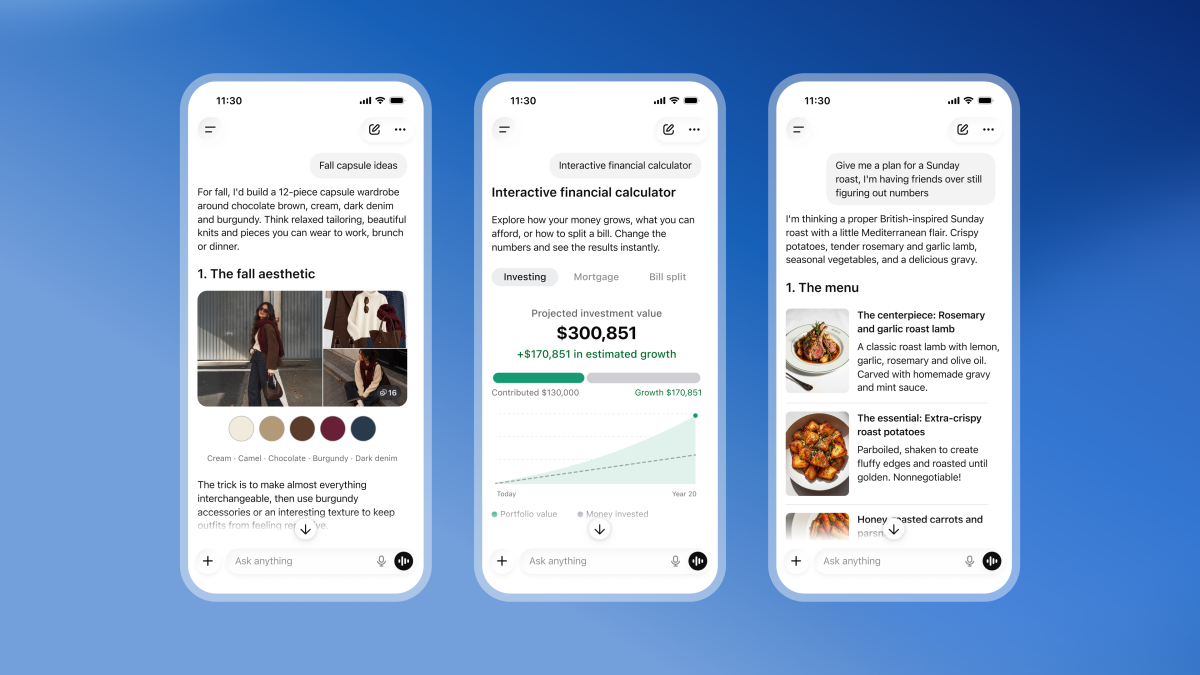
ChatGPT is moving beyond answers you just read: OpenAI is adding interactive charts, editable graphs and calculators built for the question at hand. The new interface is called Intelligent UI, and OpenAI says the goal is to make complex subjects easier to learn—not to turn every conversation into a wall of visuals. In a demonstration for journalists, product manager Aarush Selvan asked ChatGPT how an airplane wing generates lift. It responded with several diagrams explaining how planes stay in the air. Other examples ranged from recipe visuals and a bicycle-mechanics diagram to a map for a multi-day hike and a personal savings calculator. The key change is that some of these elements are usable: a person can edit a graph, or work with a calculator tailored to the task, rather than simply view a static illustration. That puts more of the interaction inside the answer itself. It could make ChatGPT more useful for learning and everyday planning, while also changing what users expect from a response. But OpenAI says the visual presentation is adjustable; people who prefer fewer visuals will be able to dial them back. The global rollout was scheduled to begin October 7 for Pro, Plus, Business and Enterprise accounts. Free users and subscribers to the lower-cost Go tier were scheduled to get it October 8, according to TechCrunch. So the new interface is planned for both paid and free users, with a one-day gap between them. The larger test is whether these built-in controls make an answer easier to understand and act on—and whether users can still choose the kind of response that suits them. That shift toward AI people can use—and evaluate—also puts verification in focus. Google has opened a public SynthID checker worldwide in English, at SynthID.com. It looks for hidden watermarks in images, video and audio, including supported signals from OpenAI, Nvidia and Kakao. Apple support is expected later. A detected watermark is evidence of a supported signal, not a verdict about whether something is true or misleading. And no detection is not an all-clear: AI media without a watermark the checker recognizes falls outside its coverage. Users must sign in, and Google allows about 10 checks per day across all three media types. The company says the limit helps stop people from using repeated tests to develop watermark-removal tools. The practical lesson is to treat this as one check, not a universal authenticity test. The same need to check what AI can uncover—and what remains uncertain—appears in healthcare security. Epic has paused most product development to address flaws Claude Mythos found in some customer configurations of MyChart, its patient-record software. Epic’s security chief said outsiders could potentially access records without the software logging an intrusion. The model did not establish whether records could also be changed without detection. Epic has not disclosed the technical details or confirmed when the work will be complete. CEO Judy Faulkner said in September the pause would likely last six weeks, but that is not a completion date. The repair also has to happen while healthcare providers keep using the systems. MyChart is used for more than 320 million patient records, though Epic says it does not have access to customers’ medical data; providers are responsible for that information. AI can speed up the search for weaknesses, but fixing them still means balancing security with continuity of care. And in finance, the human review burden is already measurable—at least among the executives in one survey. In Datarails’ July online survey of 270 finance leaders at large U.S. organizations, respondents said they spent an average of 26 percent of their workweek checking or correcting AI output. Only 7 percent said their finance function was fully ready to implement AI across all workflows, while 53 percent planned to expand licenses. Those figures are self-reported, from a survey conducted for an AI finance software vendor; they are not an industry-wide measurement. Still, the tension is clear: adoption plans are growing even as review remains central. Only 5 percent said they trusted AI to produce board-ready financial reports without review. The useful thing to watch across these stories is not just whether AI adds features, finds vulnerabilities or gets more licenses. It is whether people have reliable ways to inspect the results—and enough control to act on them safely.