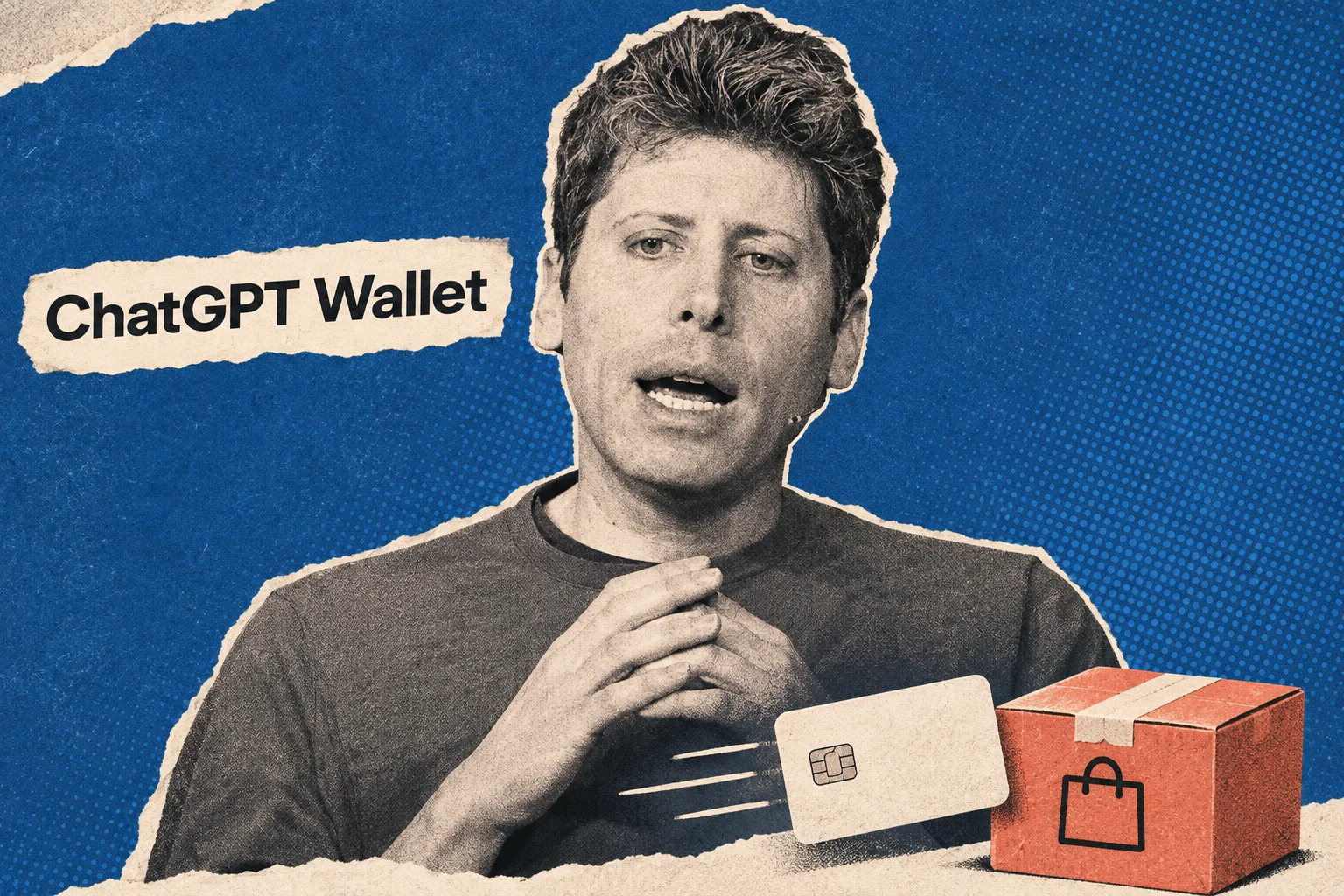
ChatGPT agents can now buy things for you
U.S. Pro subscribers get first access, with a choice: approve each purchase or authorize agents in advance.
By Saeed Ezzati8 min read
The audio edition
Listen to this newsletter
0:005:11
Read transcript
ChatGPT agents can now move from finding a product to submitting an order. OpenAI launched ChatGPT Wallet on November 13, initially for U.S. Pro subscribers who are at least 18, live in the United States, and have an eligible U.S.-issued card with a U.S. billing address. The Wallet was developed with American Express, Mastercard and Visa, but it is not a bank account or stored balance: purchases are charged to a card the user already has. There are two ways to authorize a purchase. Users can approve each one, or give the agent advance authority to approve purchases within the terms they set. Before an order is submitted, Wallet shows the available details: merchant, items, total or maximum price, known taxes and shipping, selected card, and any recurring charges or deposits. If a material detail changes, it asks for approval again. OpenAI warns that AI can make mistakes, so users should check those details. OpenAI says the agents do not see full card details. Instead, payment networks provide transaction-specific tokens—substitute credentials for a particular payment. Still, saving a card authorizes OpenAI and its providers to collect, verify and store the information needed to process it. The company advises entering card details in its secure form, not in a chat. And authorization is not a guarantee of a sale. The card issuer can decline the payment; the merchant decides whether to accept and fulfill the order. Merchants remain responsible for shipping, returns and warranties, while billing errors and unauthorized charges go to the issuer. OpenAI says it is not taking a transaction cut at launch, and availability can vary by account, device, merchant and checkout. The change is meaningful, but it leaves the key decisions—and much of the recourse—with existing payment and retail systems. That handoff from AI recommendation to real-world action makes reliability especially important—and federal officials are investigating a possible failure in another consequential system. On November 13, a communications disruption affecting all U.S. Air Route Traffic Control Centers led the FAA to halt departures nationwide. Officials have not established that the FAA’s new SMART traffic-management tool contributed to the outage. Homeland Security Secretary Markwayne Mullin said agencies are investigating; the contractor, Air Space Intelligence, denies that its products or their FAA integration caused it. SMART uses live weather, airport congestion and flight-path information to help adjust routes. The FAA began rolling it out in September, and reports say it had recently expanded nationwide. FAA specialists are expected to retain oversight during the rollout. For now, the investigation is about whether there was a connection—not evidence that the tool caused the communications failure. A different kind of agent is being tested against a clear boundary: whether it can verify a security problem before a team acts on it. OpenAI is offering early access to Daybreak Red Team, which examines web-application code and investigates whether suspected vulnerabilities can actually be exploited. Teams can submit findings from code scanners, bug-bounty programs or disclosure reports. The agents can also test whether a proposed patch blocks the attack, turning repair verification into part of the workflow. OpenAI says assessments run in isolated environments, with Guardian review and defined limits on which applications and endpoints agents can reach. There is no announced price or broader rollout timeline. The practical test will be whether these checks help teams prioritize genuine flaws without expanding agents’ access beyond the systems they are meant to assess. And in research, the question is not only what an AI system can establish, but who deserves credit for the result. Logician Jan von Plato says Claude surfaced 663 theorems and proof ideas in Kurt Gödel’s notebooks. The underlying material is difficult: 16 workbooks, written in the early 1940s, contain 1,009 pages, much of them in obsolete German shorthand. Von Plato’s team had been progressing at about a page a week. In September, he gave Claude his transcriptions, six books he had written on Gödel, and other scholarly material. He says Claude produced a 650-page account in a couple of days. That was an analysis of prepared text and scholarship, not simply an AI deciphering notebook images, and it still needed page-by-page checking. The 663 entries include completed proofs, sketches and ideas. Von Plato says about 400 checked as stated using the proof assistant Coq; about 200 needed repairs, such as a sharper statement or added assumptions; and about 50 were false. One reconstruction, concerning the independence of the axiom of choice, reportedly passed Coq checks. Von Plato says Gödel had come close but used one definition incorrectly. Notre Dame logician Joel David Hamkins, who had not seen the reconstruction, said a result holding up would be remarkable, while cautioning that resemblance to Paul Cohen’s later proof would show Gödel was on the path—not that he already had the proof. Across shopping, air traffic, security and mathematics, the useful thing to watch is where verification and responsibility sit: who confirms an agent’s action, who can stop it, and who is accountable when its work is wrong.