ChatGPT and Codex will share one usage budget
Plus, Pro and Business subscribers switch in December; instant chat stays outside the shared allowance.
By Saeed Ezzati8 min read
The audio edition
Listen to this newsletter
0:004:14
Read transcript
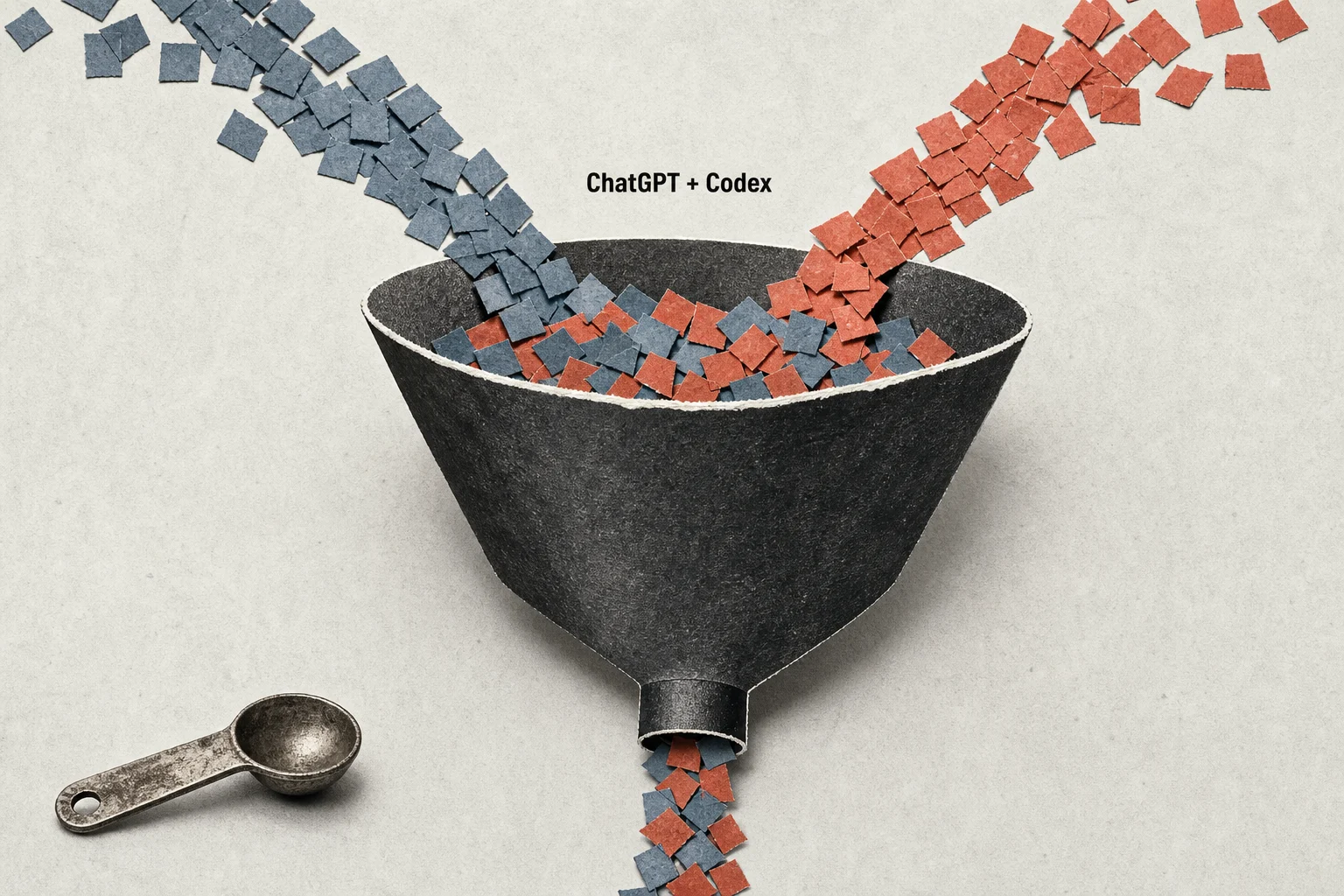
OpenAI is replacing separate ChatGPT and Codex allowances with one shared, token-based budget for Plus, Pro and Business subscribers, starting in December. Instant chat is excluded, so the change applies to usage across the two products outside that feature. The shift is tied to bringing Work’s agent capabilities into the main ChatGPT experience. The meter will count both the information sent to a model and the information it generates. How quickly the budget runs down will depend on the model and task: OpenAI says more advanced models and more complex work generally use more of it. So a long or demanding Codex task may draw on the same allowance as other eligible ChatGPT work. The key numbers are still missing. OpenAI has not disclosed how many tokens each plan will include, how often allowances reset, or the exact day in December when the change starts. That leaves subscribers without a way to compare their current capacity with what they’ll get after the switch. OpenAI expects most people won’t need to wait for resets more often, but that’s a forecast, not a guarantee. Subscribers will be able to see their combined remaining allowance and reset times under Settings, then Usage. If they use it up, OpenAI lists three options: wait for a reset, upgrade, or buy credits for eligible features. For anyone building a workflow around Codex or ChatGPT, the practical question isn’t just how much the meter counts—it’s whether the final plan-level budgets match the work they rely on. That question of where AI’s boundaries sit is also at the center of MIT’s decision to end its evaluation of AI camera monitoring. The university says it has no plans to revisit the proposal. Its pilot with Ambient.ai used staged scenarios to test alerts for specific safety events; MIT says the pilot has ended and all its data has been purged from the company’s portal. The decision does not remove the cameras. MIT says roughly 4,600 remain in use without AI, audio recording or facial recognition. The university says footage is generally kept for 30 days and reviewed after reported incidents, subject to exceptions. Faculty and students had raised concerns about access, misidentification and the lack of community input. Student-union critics also argue that extensive recording can chill expression even without automated analysis. So the unresolved issue is broader than whether an algorithm watches: it’s who controls the footage, and what people feel safe doing under the cameras that remain. And even when a system is intended to make AI use more visible, the settings can determine whether its signal is there at all. Anthropic says it will extend text watermarking to Claude Mythos 5, Opus 4.7, Opus 4.6 and Sonnet 4.6 on November 3. But, according to The Decoder, changing any one of three word-selection settings from its default disables the watermark on Opus 4.6 and Sonnet 4.6. Anthropic says the watermark works by guiding word choices into a pattern that a detector can check; it isn’t a visible label. The company ties this rollout to the EU AI Act’s December deadline. Its detector is still in private preview, and a positive result can suggest Claude helped produce text, but can’t distinguish writing from heavy editing. A missing mark proves even less: it cannot establish that a person wrote the passage. For developers relying on the mark, the immediate detail to check is whether those generation settings are still at their defaults. Finally, the debate over shared limits has a hardware counterpart: who gets to use scarce computing resources, and for what. In an October 29 interview with John Collison, OpenAI CEO Sam Altman argued that limited memory is better used in highly utilized cloud systems than sitting in personal computers that, in his characterization, may use it only five percent of the time. That figure was not presented as a measurement across PCs. Critics quoted in coverage pushed back on ownership and corporate control, while consumer memory also supports gaming and other non-AI uses. The larger thread across these stories is that efficiency is only one way to judge an AI system. Limits, defaults and surveillance policies also determine who has control and what choices remain. Watch for the concrete terms behind the promises: OpenAI’s actual plan budgets, the settings that preserve Anthropic’s watermark, and the rules governing how institutions collect and use data.