Google’s Gemini builds practice worlds for robots
Google reports real-robot gains, but leaves some attempt counts out. Apple benchmarks four linked Macs.
By Saeed Ezzati8 min read
The audio edition
Listen to this newsletter
0:005:51
Read transcript
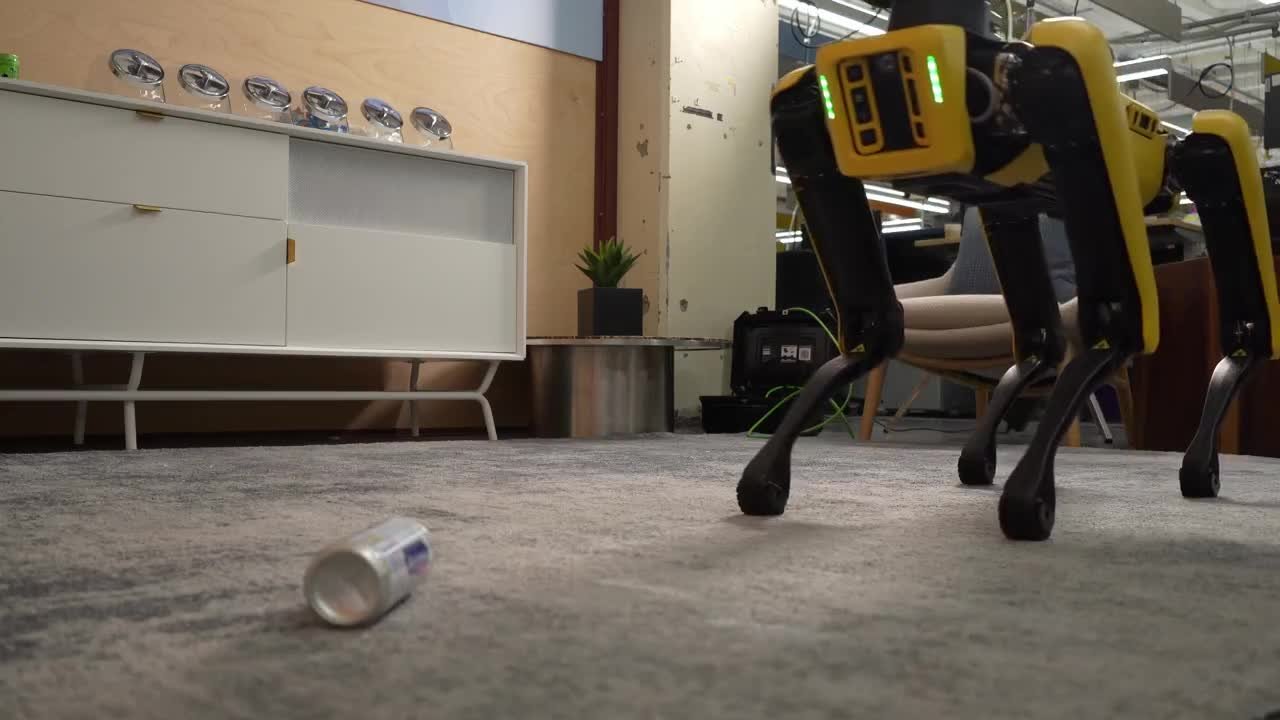
Google is opening Gemini 4 Argon for robot control, virtual practice and training-data evaluation—and its demos show how those jobs might fit into one loop. But the performance evidence still leaves a basic question unanswered: how reliably does it work? In one demonstration, Argon builds a virtual trash bin. A Boston Dynamics Spot robot practices balancing on three legs before trying the pedal on the real bin, while two other AI agents check its foot and gripper positions. In another, Argon turns a photo of party props into a virtual replica, creates 77 tasks and generates more than 4,500 training episodes. Google reports that training with these simulations improved real-robot performance, but it hasn’t disclosed how many attempts produced the reported success rate. There’s still substantial human scaffolding, too. A cup-righting example is called zero-shot, but the model gets a camera image with a centimeter grid and ready-made movement commands. And a simulation showing a humanoid throwing boxes demonstrates simulated motion, not a successful physical throw. The benchmarks also test different abilities. Google says Argon scored 87 percent on ERQA, a 400-question physical-reasoning test, ahead of Claude Opus 5.5 and GPT-6 Astra. But on Artificial Analysis’s benchmark, where models directly control a real robot arm, Argon placed third, with 55 out of 100 points; GPT-6 Astra scored 69, and GPT-6.1 Sol scored 65. Reasoning about physical tasks and controlling hardware aren’t interchangeable tests. Google opened Argon on October 13. Google AI Ultra subscribers can use it in AI Studio and Antigravity, and developers can access it through the paid Gemini API. PYMNTS reports introductory pricing of two dollars per million input tokens and ten dollars per million output tokens, doubling after November 30. The demos connect simulation, action and feedback; the missing attempt counts and individual failure rates are the important counterweight. Beyond robots, the same question of reach—and proof—shows up in Meta’s speech tools. TIME named Omnilingual ASR to its Best Inventions of 2026 list. Meta says the open-source speech-recognition models support more than 1,600 languages, including over 500 that had never previously been served by an ASR system. The notable design choice is that the language list isn’t meant to be fixed. Meta says communities can add an unserved language using a handful of their own samples. The system includes smaller models for low-power devices as well as larger versions aimed at accuracy. Meta says its training combines public resources with recordings gathered through compensated local partnerships. There’s already a reported use case: TIME says Nigerian health practitioners are using the tool in community clinics. But it reports no measured patient outcomes, so the practical impact remains unquantified. And transcription is only one part of the workflow: Meta’s separate Omnilingual Machine Translation system can translate the resulting text across more than 1,600 languages. Meta’s ambition is broader coverage; the useful thing to watch is whether that coverage holds up for communities using the tools in real settings. That gap between a model’s promise and the conditions needed to run it is visible in Apple’s distributed-computing tests. Apple says four Mac Studios linked together generated more than 36 tokens per second from Muse Spark Open. The compressed model occupies about 493 gigabytes, but its working-memory needs push it beyond what one 512-gigabyte Studio can handle. Apple’s MLX framework can split the model across machines in different ways. Pipeline parallelization passes work from one computer to the next; tensor parallelization lets machines calculate parts of a layer together, potentially speeding up output, but also requires more communication between them. So faster generation doesn’t automatically mean a shorter wait for the first answer. For a 65,536-token input, Apple measured the initial wait falling from about 50.5 seconds to 40.6 seconds when it used two Thunderbolt cables per link instead of one. The setup illustrates the tradeoff: large models can run on local hardware, but memory, cabling and communication overhead all matter. The relevant performance question is not just how fast tokens appear, but how long the whole job takes on the hardware a team can actually deploy. And for business workflows, NVIDIA is pushing open-weight models into document analysis and local agents. Its 120-billion-parameter Nemotron 3.5 Super VL is designed to handle PDFs, charts, tables, images and webpages, and to use tools. NVIDIA also highlights customized versions trained for narrow assignments, including vendor-credit finance and credit-agreement analysis. The company says those versions beat named Claude and GPT rivals on their respective specialized tests. But VentureBeat reports NVIDIA supplied no task definitions, sample sizes or testing protocols, so those comparisons are difficult to assess independently. The smaller Bolt 74B-A9B targets multistep work on local systems. NVIDIA says its two-bit compression lets it fit in 24 gigabytes of memory, and that it can run alongside other applications on RTX Spark and DGX Spark systems. A smaller Bolt E4B version, aimed at uses such as voice assistants and embedded interfaces, is scheduled for October 23. NVIDIA’s OpenMDW license permits commercial use, fine-tuning and redistribution. Across these releases, the practical test is the same: performance under real operating conditions, not a headline score or demo alone. Watch for disclosed failure rates, task definitions and end-to-end results—including hardware and communication costs—before treating a capability as dependable.