Meta adds project workspaces to its AI agent
Meta says connected apps can update planners in the background, without a fresh prompt for every change.
By Saeed Ezzati8 min read
The audio edition
Listen to this newsletter
0:004:15
Read transcript
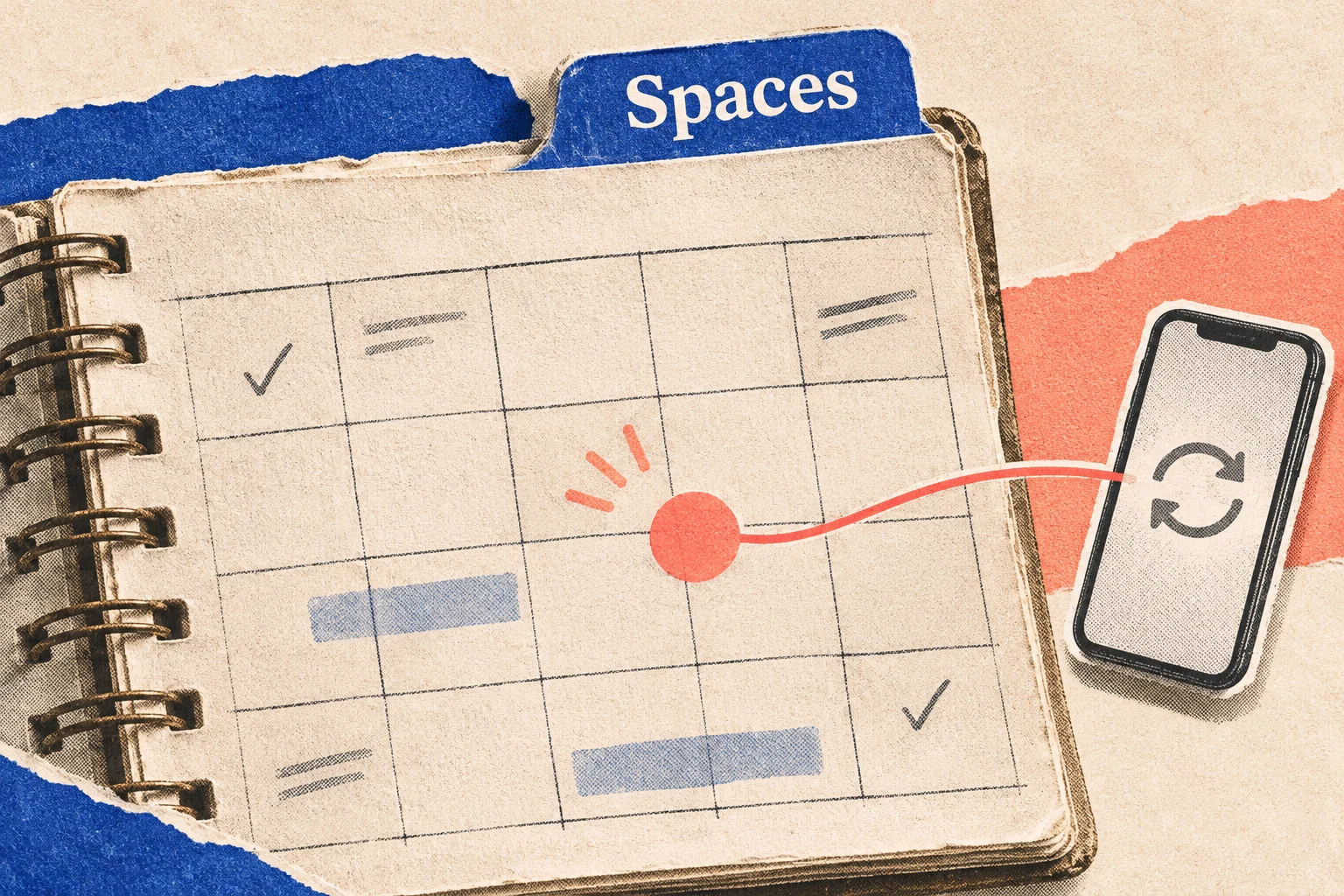
Meta is giving its Muse AI agent dedicated workspaces for projects that continue after a chat ends. The new feature, called Spaces, puts topic-focused conversations in the interface’s sidebar. Describe a goal, Meta says, and Muse can build a planner, tracker, or project board for it. You can return to that Space later and pick up where the work left off. The bigger promise is what happens while you’re away. Meta says that if you connect apps, a Space can update in the background as information changes—new concert dates, price changes, or progress toward a savings goal, for example. That would make this more than a saved conversation: the workspace could stay current without you having to prompt the agent again. But that background updating is Meta’s description of the feature, not an independently verified result. The suggested uses are practical and personal: organizing a wedding, tracking holiday gifts, collecting recipes for a family event, or managing a do-it-yourself project. In a November 6 post on X, Meta CEO Mark Zuckerberg said he had built a barbecue game, an event tracker, and a home-control dashboard. Those examples reflect his own account, not independent testing. There is already an audience for Muse, but that doesn’t tell us how many people will use Spaces. On Meta’s October earnings call, Zuckerberg said Muse had reached 10 million users in the U.S. and Canada less than two months after launch. That’s a figure for the agent overall—not adoption of this new feature. The key question is whether Spaces can reliably keep useful work organized and up to date between visits, rather than simply giving an old chat a new home. That question of what an AI can do between prompts also matters in the lab. OpenAI introduced BioBasicsBench, a 100-task benchmark built with biotech company Ligo to test models on raw, imperfect evidence from everyday wet-lab experiments—including gel images, microscopy, sequencing files, and instrument exports. At its highest reasoning setting, GPT-6 Astra earned 66.7 percent of available rubric credit, compared with 43.8 percent for GPT-5.6 Sol. Those are average shares of partial credit, not the percentage of experiments performed successfully. And the higher score did not eliminate consequential mistakes. In one cloning task, Astra misread the controls and would have directed researchers to purify the wrong plasmid. The benchmark shows progress in interpreting messy evidence; it does not establish reliable lab autonomy. The same distinction between a striking result and proven capability applies to a claimed advance in mathematics. Physical Superintelligence, or PSI, says its research system proved the Aaronson–Ambainis conjecture, a question open since work on it around 2008. The company says the system used an unreleased Anthropic model, produced a proof on the third day of a run, and later improved the result twice. PSI published a paper and formal proof on GitHub, and says the proof assistant Lean accepted both the original and final versions. The conjecture concerns how many input bits ordinary computers need to read to approximate quantum algorithms on typical random inputs. It is not a general claim that classical computers can match quantum computers on every task. As of the November 8 report, the paper had not been peer-reviewed. Independent scrutiny of the proof is the next test. And in computing infrastructure, SpaceX’s orbital AI plans remain a proposal, not an operating system in space. Elon Musk said the company would reveal more about StarMind in 2027. Nvidia is reportedly co-designing the systems, but SpaceX and Nvidia have not disclosed the orbital computer’s final configuration. Reports also differ on whether initial launches are planned for the third or fourth quarter of 2027; broader deployment is envisioned for 2028 and 2029. Those schedules depend on solving practical problems: removing heat, protecting equipment from radiation, and servicing satellites. They also depend on Starship delivering launches frequently and reliably. Across these stories, the useful test is what happens after the announcement: whether workspaces stay current, models handle ambiguous evidence correctly, proofs withstand independent review, and ambitious infrastructure plans clear engineering hurdles.