OpenAI adds agents that work between chats
ChatGPT’s shared pages launch for teams, while collaborative slides, spreadsheets and mobile editing are still coming.
By Saeed Ezzati8 min read
The audio edition
Listen to this newsletter
0:003:44
Read transcript
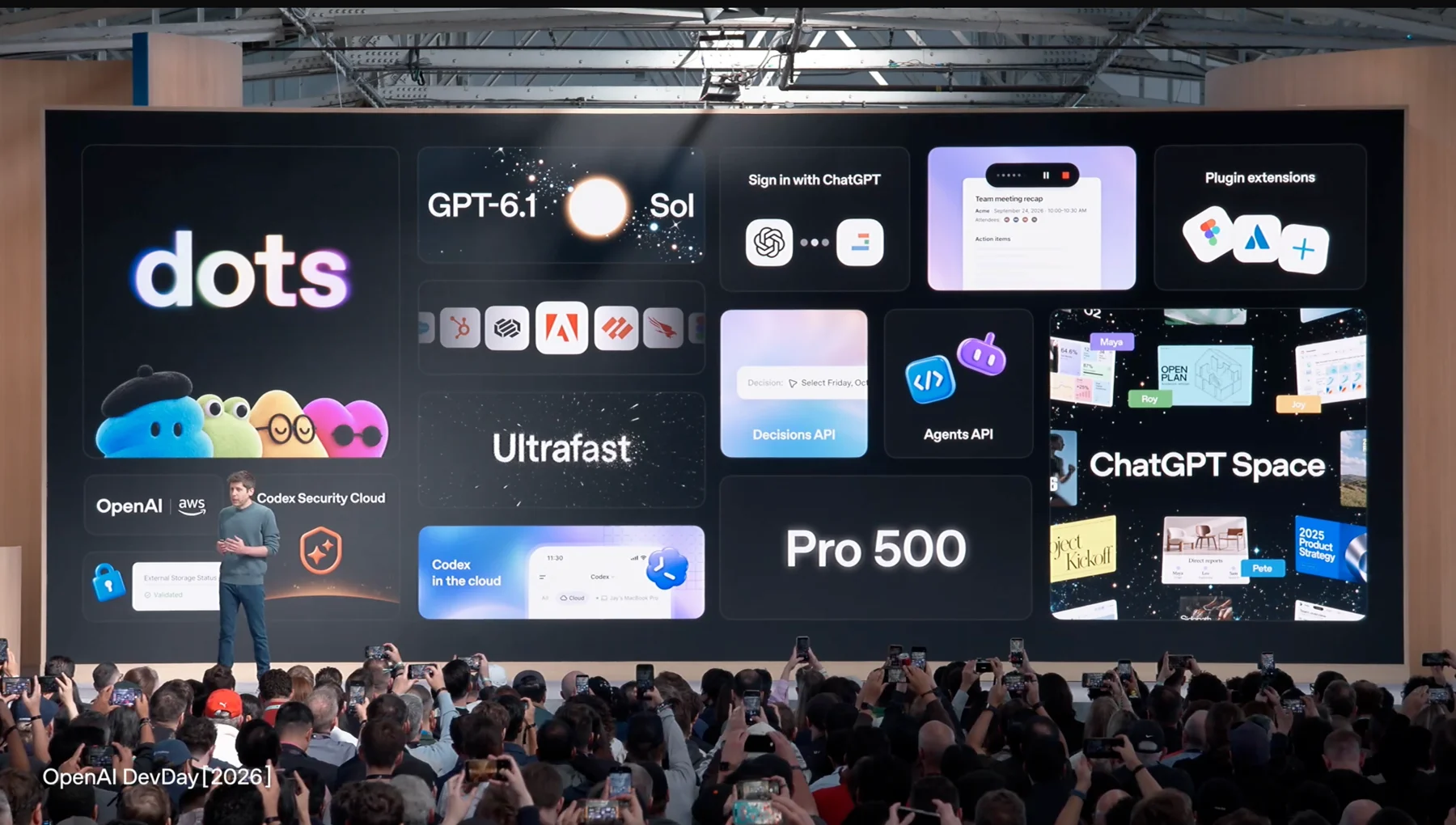
OpenAI is pushing ChatGPT from answering a question to carrying work forward after the conversation ends. At its September 29 DevDay, it introduced Dots, personal agents with their own cloud computer and browser. They can work across more than 4,000 connected applications, research, write and test code, then bring results back for a person to review. Users choose the tools and boundaries; consequential actions require approval, and proactive background research uses read-only tools. Delegated work can still use up Work and Codex allowances, so an agent that keeps running is not unlimited work for free. Access varies. Dots start with Pro and Business Premium in eligible markets. Enterprise, Edu and Healthcare have administrator-enabled betas, off by default. And an announced rollout does not mean every eligible account already has access. The second piece is Space, a shared home for pages and files that replaces Library for eligible users. Teammates can co-edit pages, comment and ask ChatGPT or a Dot to make changes. It launches on Pro, Business and Enterprise, with creating and editing on web and desktop. Mobile users can find, read and share pages, but editing on mobile and collaborative slides and spreadsheets are still coming. Projects remain separate, and automatic page updates are not available yet. OpenAI also introduced GPT-6.1 Sol for coding and professional work. Its standard API price is two dollars per million input tokens and ten dollars per million output tokens. Cached input is ten cents per million, half the previous Sol rate. Sol is available in the API, ChatGPT Work and Codex on eligible paid plans, not regular Chat at launch. Long-context requests and premium processing can cost more. OpenAI reports better coding and factuality results, but those are company evaluations, not guarantees for a user's own workflow. The practical shift is continuity; the limits are still access, permissions, review and cost. That balance between more persistent work and tighter limits shows up in OpenAI's Pro pricing, too. The company plans to reopen sign-ups for its two-hundred-dollar plan on September 30. Thibault Sottiaux says its weekly allocation will equal half the previous plan's usage when valued at API prices. He says subscribers can spend it without a five-hour limit, but OpenAI has not specified a dollar allowance or how many tasks it covers. Features that won't consume usage are also planned, but remain unnamed. The API comparison alone cannot tell a buyer how much work their own workload will get done. And in research, longer-running AI work still ends with a scientist checking the result. Microsoft says its experimental system Quine helped researchers rank compounds for tests on pancreatic cancer cells, narrowing candidates in one weekend. Lab assays largely matched predicted shifts in cell states, including movement toward a third state the researchers had not initially framed. That result offers a new lead, not a treatment: the weekend was the search for what to test, not the experiments or a therapy. Quine remains a research tool, available only through its Fellows program and selected collaborations, and its outputs need scientific validation. Finally, Manus 2.0 brings the same handoff question to everyday tasks. Selected email or Slack messages can trigger automations, while Computer Use lets people direct work on approved local files and apps from a phone. Its Studio tools also let users manually edit generated games and videos. Manus says separate cloud computers can host multiplayer game servers; that does not establish how good a game is. The useful thing to watch across these launches is not just what an agent can do, but what access it needs, what its work costs, and where a person must still review the result.