OpenAI engineer charged over hidden office recorder
OpenAI says it has no indication of improper access to code or customer data; the FBI investigation continues.
By Saeed Ezzati8 min read

The audio edition
Listen to this newsletter
0:004:45
Read transcript
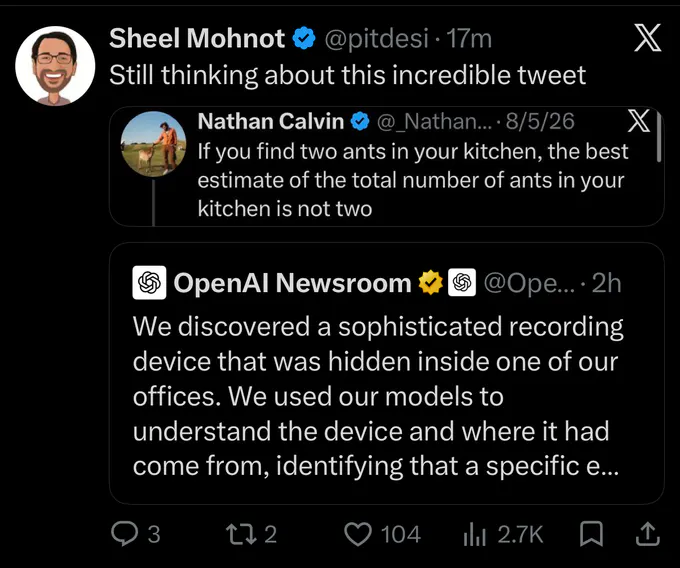
OpenAI says its models helped investigators analyze a hidden recorder allegedly planted in a conference room used for confidential executive discussions. Federal prosecutors say engineer Abdulrahman Alfozan was arrested on October 13 and charged with using or attempting to use a device to intercept oral communications. He remains in federal custody; the charge is an allegation, and the FBI investigation is ongoing. Employees found the recorder on September 30, plugged into a USB port behind a television and concealed in toilet paper, according to the complaint. OpenAI says it determined the device was installed around September 28. Its contents were encrypted. Prosecutors describe the room as a regular venue for discussions about research, product plans, business strategy, and government and commercial relationships. The complaint alleges surveillance footage showed Alfozan repeatedly near the room, although he was not authorized to enter or attend meetings there. It also cites questions from a chatbot account allegedly tied to his spouse. Prosecutors say the account asked about hiding a recorder and included details specific to the device that was recovered. Those claims have not been established in court. OpenAI says investigators used its models to examine forensic images of the recorder’s storage and assess changes in the underlying data. The company says it gradually restricted Alfozan’s access after discovering the device, then coordinated the timing of his firing with the FBI so as not to disrupt the investigation. OpenAI says it has no indication that he improperly accessed or removed model weights, source code, or customer data. A detention hearing is scheduled for October 19. The point here is narrow but consequential: AI tools were used as part of a company’s forensic investigation, not as proof of who was responsible. The allegations, the encrypted device, and the lack of indicated access to core assets are distinct facts—and the investigation will have to establish what happened. On the broader security front, XBOW says a researcher working with AI agents built a Chrome exploit chain that Google reproduced, patched, and rewarded with a $250,000 bounty. The chain linked three bugs on Windows to cross two sandbox boundaries, potentially allowing code to run outside Chrome after a user simply loaded a web page. The six-day build was a replacement for an earlier chain that did not qualify because Google already knew about one of its bugs. XBOW says the replacement used about $40,000 in compute, following months of broader research. Its estimate that roughly a billion Windows Chrome users were exposed describes potential exposure, not a count of victims; XBOW says the flaws were never used against users. The company also credits researchers with setting strategy and checking the agents’ work. Its practical advice is simple: keep Chrome updated and restart when its Update button appears. The infrastructure side of the same AI-driven pressure is showing up inside Anthropic, where the company says Claude-assisted development pushed source control into the role of its biggest coding bottleneck. Over five months, Anthropic moved from Git to its own system, Scion, as daily merged changes rose from about 2,500 in May to more than 30,000 in September. Scion shifts operations such as creating commits and answering history queries onto servers. Clients keep a bounded cache, and automated jobs can request code differences without maintaining a full local repository. Anthropic reports that CI and research checkouts became 100 times faster, while CPU and memory needs fell to one two-hundredth of its former Git-mirroring infrastructure. Those are company-reported results from an unusually large workload: Anthropic says Git remains right for the vast majority of repositories. The lesson isn’t that every team needs a new version-control system; it’s that agent-heavy development can make infrastructure, rather than code production, the constraint. And as AI makes it easier to create software, Google is opening a carefully limited route to putting personal apps on Android. U.S. users aged 18 and older can install apps they build with Google AI Studio through Google Play, without publishing them publicly. At launch, only the creator can access an app; it won’t appear in search or public listings, and existing Play policies still apply. Sharing with trusted friends is planned for the months ahead, but it isn’t available yet. Google says an app that gains broader appeal could later move to a public listing after trust and safety reviews. Across these stories, the useful thing to watch is how safeguards keep pace as capability and access expand: the FBI’s findings in the OpenAI case, the response to newly found software flaws, and the limits Google sets as private apps move toward sharing.