Sakana AI gives agents a shared business playbook
Aquarium includes human approvals and execution records, but pricing and a general-availability date are undisclosed.
By Saeed Ezzati8 min read
The audio edition
Listen to this newsletter
0:004:53
Read transcript
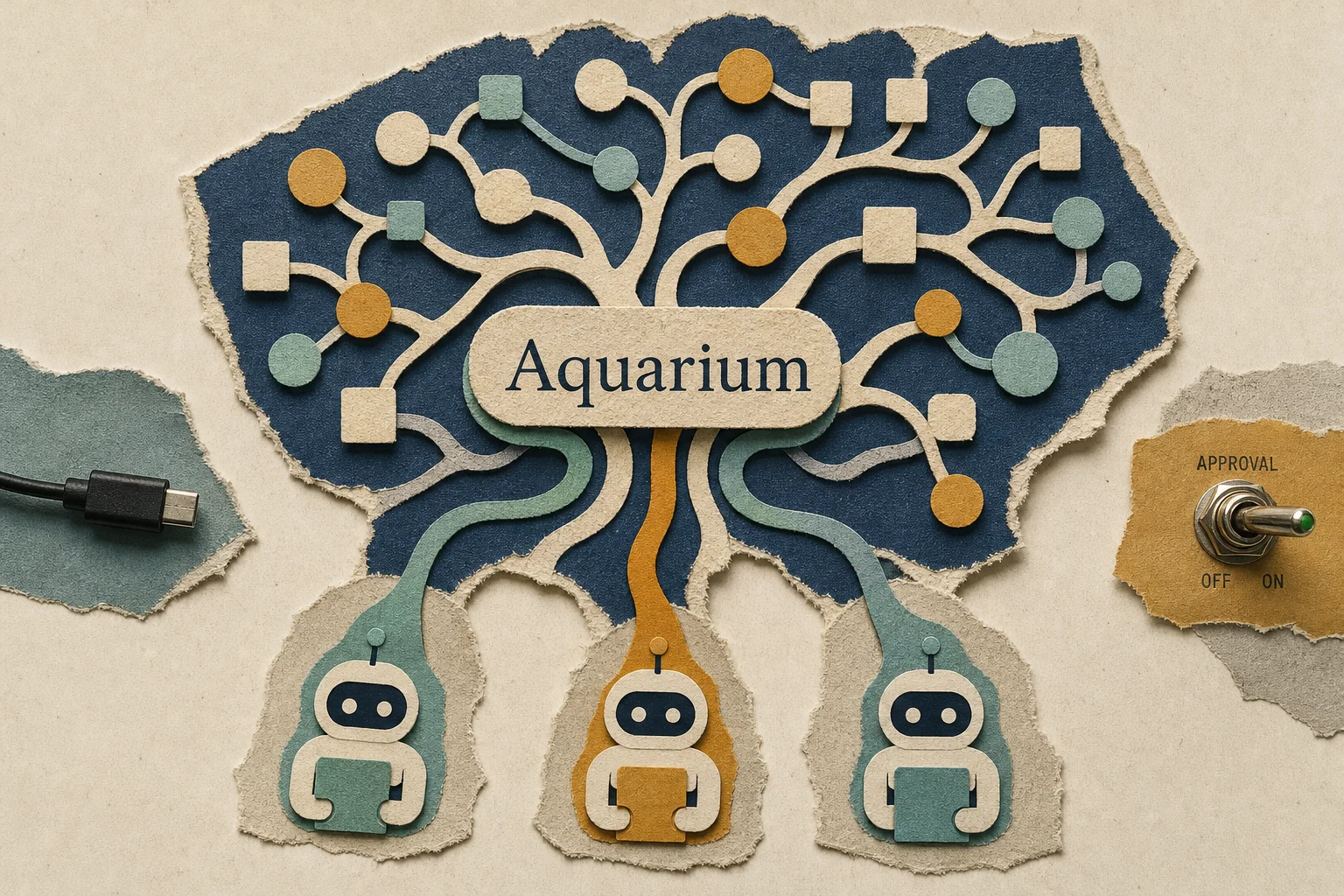
Sakana AI’s new platform, Aquarium, is built around a simple idea: companies shouldn’t have to rebuild the same business knowledge and controls for every AI agent. Introduced October 23, it gives multiple agents a shared foundation of data connections, business definitions, decision rules and operating controls. At the center is an organized map of how a business’s information fits together: what terms mean, how data relates, and which criteria should guide a decision. Sakana says Aquarium can connect information in tables and documents while leaving the underlying data where it already lives. When that information changes, agents can use the updates. Workflows can combine retrieving information, AI judgment, function execution and human approval. Teams set permissions and approval requirements before an agent acts. Records then trace what information it consulted, what decisions it made, which approvals it received and what happened. Sakana also says teams can monitor execution speed, accuracy and model usage. The point is to reuse more than the agent itself. Connections and business knowledge prepared for one agent can support others on the same foundation. Sakana says the idea grew out of repeated work on finance projects with Mitsubishi UFJ Bank, SMBC Group and Daiwa Securities Group. Those are earlier projects that informed the platform, not newly announced Aquarium deployments. This isn’t a plug-and-play rollout yet. Adoption starts with consultation and joint construction and validation, initially around one operation. Sakana has announced neither pricing nor a general-availability date. It describes AI-assisted agent construction and updates based on operational feedback as planned capabilities, not features available now. The practical question is whether a shared foundation can make agents easier to govern without making every workflow a bespoke integration project. And that same push for reusable agent infrastructure raises a design question: how many agents does a workflow really need? Anthropic’s October 22 guidance says a single agent, loading specialist instructions only when needed, often performed better in its deployment comparisons than a fixed network of subagents. In one customer example, a system with roughly a dozen specialists made brand voice harder to maintain and added delays. Another customer measured about twice the execution speed with one agent loop. But simpler isn’t automatically safer: in a support example, combining agents reduced latency, and the main agent skipped a required shipping-date check in one of two runs. Anthropic recommends shared end-to-end tests, merging one specialist at a time, and checking which individual tasks have regressed—not just the overall score. Subagents can still make sense when tasks need to run in parallel, context is getting crowded, or tools and instructions conflict. The useful test is the completed task, including the steps an agent might otherwise leave out. That emphasis on testing real workflows also applies to Meta and Cerebral Valley’s virtual AI hackathon, where the application window is short and the rules are not yet final. Applications are due October 25, or earlier if 20,000 people are accepted. The event is scheduled for October 26 through November 4, with a million dollars in prizes across indie and startup tracks. Selected participants get access to Meta models and $150 in Meta Model API credits. Entry is free, but selection is not automatic: organizers assess both the proposed project and the applicant’s technical experience. Official rules are still pending, and organizers reserve the right to change dates. The event listing also labels its start time EST, while detailed deadlines use ET; it does not confirm a separate kickoff livestream time. Applicants should check the event page for updates before planning around the schedule. And as more agents move from experiments toward real-world tasks, banks are drawing a clear line between access to information and authority to act. Axios reported that major U.S. banks are tightening restrictions after some customers reportedly supplied agents with their own login credentials. Reuters could not independently verify Axios’s specific cases, and Morgan Stanley said it had not observed rogue-agent access. The reported restrictions are not a blanket ban on AI tools reading financial data. JPMorgan permits limited, view-only access through approved intermediaries such as Plaid; that does not authorize transfers or bill payments. Citi says third-party agents cannot log in or transact directly on its banking platform, while allowing certain read-only access through approved providers. The shared issue across these developments is not simply whether an agent can perform a task. It’s whether teams can verify what it used, what it changed, and whether it followed the required steps. Watch for clearer rules around permissions and approvals—and for evidence that agents can pass end-to-end tests before they’re trusted with consequential actions.