Google wants AI videos to stop changing between scenes

A ten-minute film shows connected scenes, but it tests just one of Google's four research systems.

By 7 min read
Google wants AI videos to stop changing between scenes

The audio edition

Listen to this newsletter

About 3:29
0:003:29
Read transcript
Google is testing four ways to keep an AI-generated story from losing track of its own characters, places and details. The challenge shows up when a video runs longer than a clip: a person’s clothes may change between shots, or a room may look different when the story returns to it. And a mistake in an early asset can travel through later production. These systems coordinate existing models, including Gemini and Veo; they are not a new video generator. One acts like a co-director. Given a person’s creative brief, it plans a story and visual style, directs agents to make storyboards, shots and audio, then asks a model to assess the assembled cut and guide another production pass. A second system, CANVAS, keeps references for characters, places and objects, so a story can retrieve them after moving elsewhere. A third, A-squared-R-D, generates video in connected segments. It saves context from earlier segments, then can either move into a new story beat or anchor a scene to people and places already shown. Google’s ten-minute film demonstrates that segment-based approach. It does not test all four systems working together. The fourth system, V-Q-Q-A, asks targeted visual questions about a generated video. Answers guide a revised prompt and another generation; it does not directly repair faulty frames. Google reports gains in consistency and character persistence, but the supplied account gives no figures. These are research systems, and selected examples do not establish how reliably they can hold together other long stories. That gap between a promising demonstration and dependable use matters even more when the stakes are personal. MIT researchers built a lightweight tool that estimates suicide risk in crisis-text conversations and highlights words contributing to its estimate. They tested it on about 16,000 de-identified exchanges from Crisis Text Line, using counselor-assessed risk categories and a clinician-reviewed list tied to 49 risk factors. The model distinguished those categories, including imminent risk. That is not evidence it can predict suicide attempts or improve interventions. A word match can miss context, too. The researchers are sharing the software and word list, but say clinical use requires further validation; human judgment remains critical. The same question of what works outside a test setting follows Feather Robotics, which has begun selling configurable robots in small quantities. The company says revenue has passed one million dollars, and prices its platform at roughly $30,000. Customers can choose AI from outside providers and adapt the hardware for particular jobs. Feather says its robots are cooking in Japanese restaurants and cleaning labs, but it has not named customers or disclosed how many machines are deployed. Sales show early demand—not reliable performance across those jobs. Customers still need to select or build the AI and application that make a robot useful on site. And Meta’s Muse puts the same proof question in front of an agent that can act across services. Meta has priced its Power plan at $20 a month and Maximum at $100, without explaining what separates them. Mark Zuckerberg also described a possible fee on purchases Muse completes; that is a future plan, not current revenue. New connections with Walmart, Best Buy, Gap and Spotify could give Muse more to do, but users must choose to link accounts. Meta says it uses secure virtual machines now and plans more privacy protections; planned features are not yet available. Across video, crisis tools, robots and agents, the useful test is not how capable a system looks in a showcase. Watch whether it performs reliably in real settings—and earns the trust and access that wider use requires.


Google wants AI videos to stop changing between scenes

A ten-minute film shows connected scenes, but it tests just one of Google's four research systems.

SPD-BEEHIIV:d66a6c63-98df-4e79-a9fd-164d75ec6794:R17:1ddc22243517628bfdf447d0
A ten-minute film shows connected scenes, but it tests just one of Google's four research systems.
Superpower DailyRead online/Account
Daily issue / The Internet EditionFriday, September 25, 2026
Our toolsSuperpower ChatGPT/WFH.team/Snipman

Today's briefing

What matters today

Longer videos, crisis-text alerts and agents that can act across services are pushing AI beyond a single clever answer. The dividing line today is evidence: Google's video systems remain research, MIT's tool needs clinical validation, and Meta's proposed purchase fees are not yet revenue.

Inside today's briefing
01Google's ten-minute AI film demonstrates connected segments, but it does not test all four of the company's video systems.
02MIT's crisis-text tool highlights words linked to assessed suicide risk, not evidence that it can predict future attempts.
03Meta has priced Muse at $20 and $100 per month, while fees on purchases it completes remain a future plan.
04Waymo reports 82% fewer injury crashes than a local human-driver benchmark over 271.3 million rider-only miles.
▶
Listen to this newsletterAudio edition / About 3 min↗
Together with
Bolter.Chat logo
Google Research Introduces AI Systems for Longer, More Consistent Videos

Lead story / research

Google tests four ways to keep longer AI videos consistent

Google Research has outlined four related systems aimed at a problem that short AI-generated clips can hide: characters, clothing and settings changing between shots. Mistakes in an early asset can also carry through later production steps. The work coordinates existing models, including Gemini and Veo, rather than introducing a new video generator.

One system acts as a co-director. Starting from a human creative specification, it plans a story and visual style, directs agents making storyboards, shots and audio, then has a model assess the assembled cut before another production loop. Another system, CANVAS, stores references for characters, places and objects so a story can return to them instead of relying on a fresh description.

A third system, A²RD, generates video in connected segments. It stores context from earlier segments and can either move the action to a new story beat or anchor a scene to people and places already shown. Google's ten-minute film demonstrates this segment-based approach. It does not test how all four systems perform together.

The fourth system, VQQA, uses answers to targeted visual questions to revise a prompt and generate another candidate; it does not repair faulty frames directly. Google reports gains in consistency and character persistence, but provides no figures in the supplied account. These remain research systems, and the examples do not establish how reliably they will hold longer stories together.

Read full story  ↗

Your take

Should an AI video co-director choose a story’s style?

Join the discussion  →

Bot fatigue anyone?

Bolter.Chat primary sponsor creative

Most AI tools hand you an agent and an empty chat box, then call that automation. It isn't. Bolter starts you from a blueprint: a process built and tested by an operator like you. Install it with one click and your agents will run the workflow end-to-end, providing receipts on every step. Built by Improbable on a decade of experience in large-scale infrastructure.

Get free access
MIT Researchers Develop Suicide-Risk Tool for Crisis Texts, but Clinical Use Needs Validation

research

MIT builds a crisis-text tool that shows words behind suicide-risk estimates

MIT researchers built a lightweight tool that highlights the words contributing to suicide-risk estimates in crisis conversations. Tested on about 16,000 de-identified Crisis Text Line exchanges, it distinguished counselor-assessed risk categories using a clinician-reviewed list covering 49 risk factors. That does not show it can predict attempts or improve interventions. The team is sharing the software and word list, but says clinical use requires further validation.

Continue reading  ↗
WFH.team logoA tool for your workflowWFH.team
A focused feed of carefully selected remote roles and practical work-from-home resources.
Feather Robotics Starts Selling Developer Robots, Claims $1 Million in Revenue

startups

Feather starts selling robots that let developers choose the AI

Feather Robotics has begun selling small quantities of configurable robots and says revenue has passed $1 million. Its roughly $30,000 platform can run AI from outside providers, leaving customers to select models and build applications for particular jobs. Feather says robots are cooking in Japanese restaurants and cleaning labs, but has not named customers or disclosed deployment counts. Sales show early demand, not dependable performance across those jobs.

Continue reading  ↗
Meta Prices Muse at $20 and $100 a Month as It Pursues Fees on AI-Assisted Purchases

launch

Meta sets Muse prices at $20 and $100 a month

Meta has priced its Muse agent's Power and Maximum plans at $20 and $100 per month, though it has not explained what separates them. Zuckerberg also described a possible fee on purchases Muse completes; that remains a future plan, not current revenue. New retailer and Spotify connections could give the agent more tasks, but users would need to grant account access. Whether those connections lead to paid use remains to be seen.

Continue reading  ↗
 

Some teams never seem to stop moving. They're on Attio, the agentic CRM.

It’s your always-on revenue engine: agents and workflows build pipeline, chase every buying signal, and move deals forward alongside your team.

Teams like Parallel, Turbopuffer, and Wordsmith build on Attio. Are you one of them?


Also worth knowing

•  Google adds study quizzes to Chrome for some desktop users

•  DeepSeek reportedly reaches a $1 billion annual revenue pace

•  Meta's current Muse setup still allows restricted staff access

•  Google says its AI agent found more than 500 web app flaws

•  Waymo reports 82% fewer injury crashes than a human benchmark

•  Google prepares to test its AI chips in orbit

•  Google offers Irish students a free year of AI access

•  Sanders and Casar introduce a bill to pause advanced AI development

•  Apple's pricier Mac Studio loses an encoding test to its cheaper sibling

Daily tool drop

6 AI tools worth knowing today

Floot MCP product preview
NOAN product preview
WFH.team product preview
Opaline product preview
VideoFlow Studio product preview
Hookest product preview
 

The Internet Had a Point

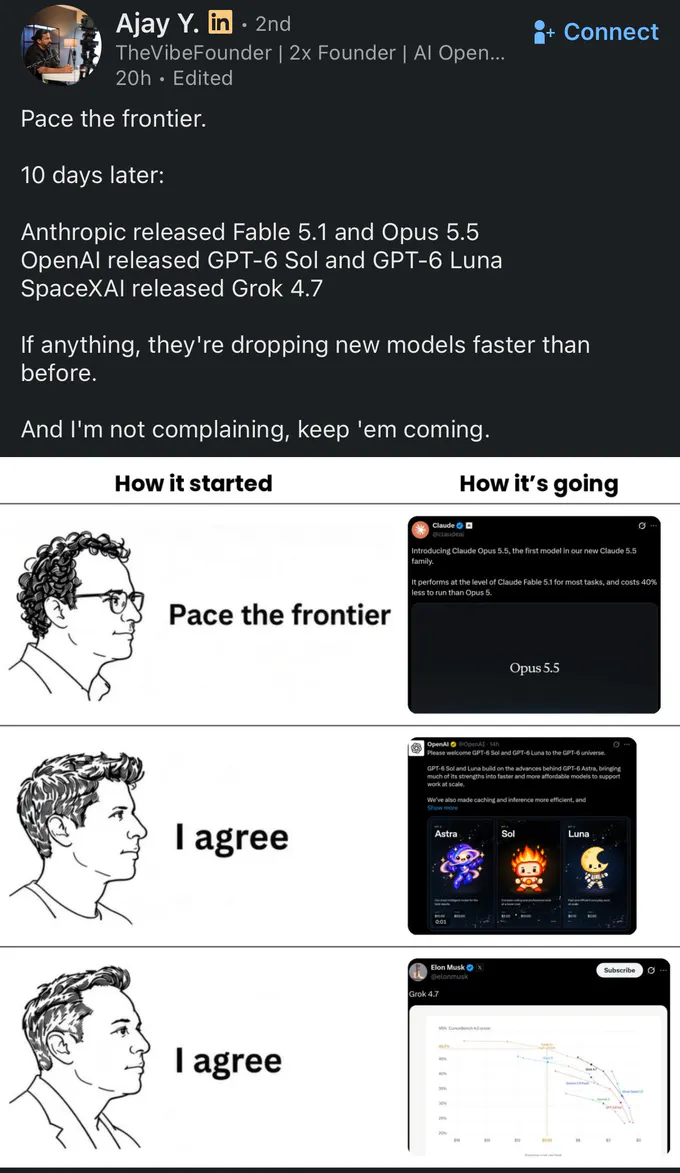
From the timelinePace the frontier, then agree
Screenshot of a LinkedIn post by Ajay Y. The post reads: “Pace the frontier. 10 days later: Anthropic released Fable 5.1 and Opus 5.5; OpenAI released GPT-6 Sol and GPT-6 Luna; SpaceXAI released Grok 4.7. If anything, they're dropping new models faster than before. And I'm not complaining, keep 'em coming.” Below is a two-column comparison labeled “How it started” and “How it’s going.” In the first row, a line-drawn person says “Pace the frontier” beside a small Claude post announcing Opus 5.5.
 

Reader check-in

Help shape tomorrow's briefing

One click tells us what to keep, improve, or tighten.

01Useful02Interesting03Too long

Prefer one email a week? Get the essential AI moves in the Sunday Weekly Digest.

Superpower Daily tracks the companies, models, products, tools, policy decisions, and cultural shifts moving AI.Follow Superpower Daily
X
LinkedIn
Discord
YouTube
RSS
Follow on Google News
Sponsor Superpower DailyEmail preferences
YOUR READING SPACE

Notifications