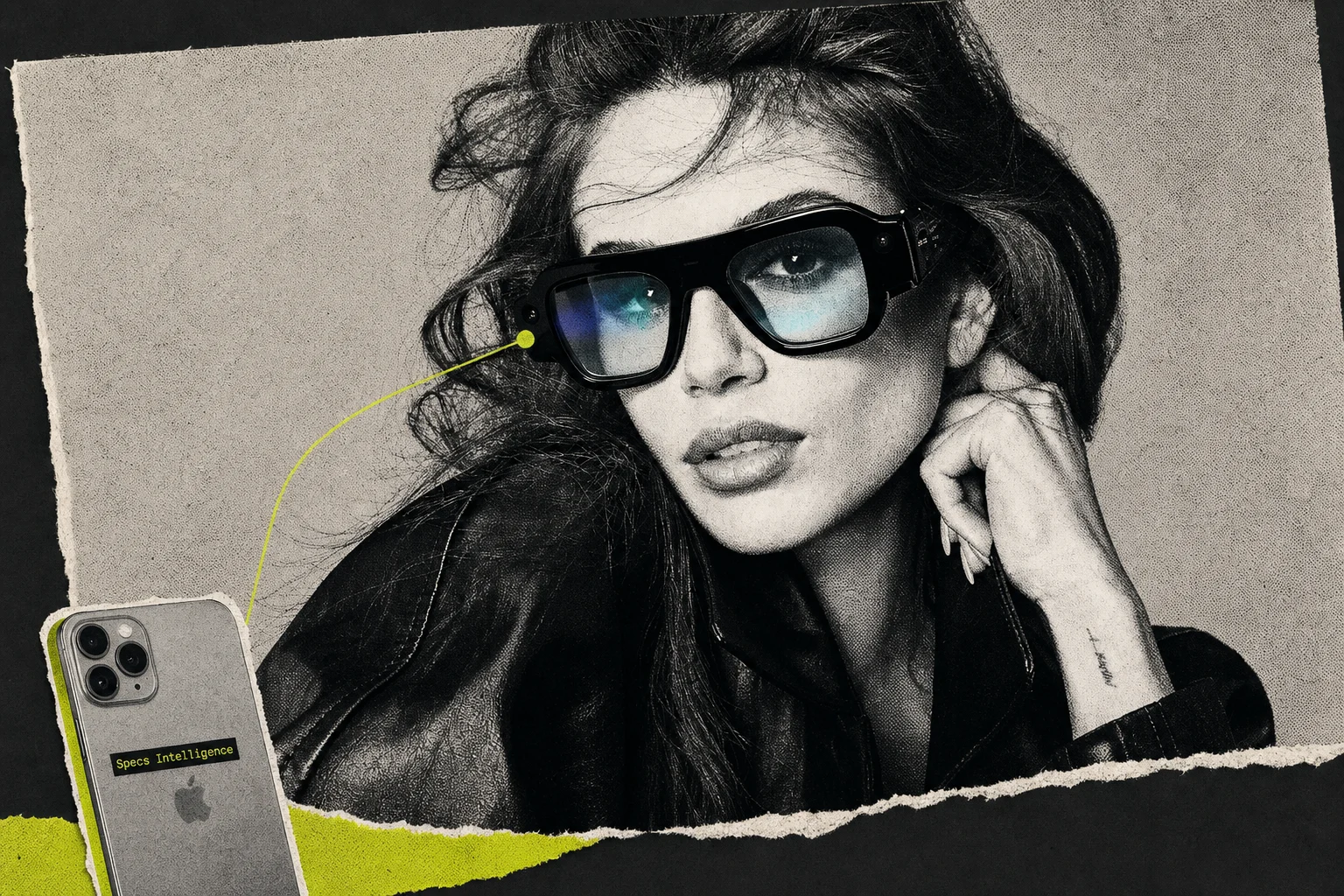
Snap pairs $2,195 glasses with an AI assistant
Specs Intelligence is already on iPhone and Mac, using apps users choose to connect to anticipate needs.
By Saeed Ezzati7 min read
The audio edition
Listen to this newsletter
0:003:45
Read transcript
The biggest move today puts AI somewhere other than a chat window: on your face, and inside the context of your digital life. Snap’s two-part release pairs $2,195 Specs augmented-reality glasses, expected this fall, with Specs Intelligence, available now on iPhone and Mac. The assistant is designed to use only the apps and tools a person chooses to connect, organizing information around work, family, and goals. Snap says it can help find a hotel, book travel, and answer questions—and calls the approach “anticipatory AI,” because it is meant to act before a request is fully formed. The glasses are the visible computer: Bluetooth calls, Spotify, photos and video, translation, games, streaming, and augmented activities. Partnerships with Tripadvisor, the NBA and WNBA, Salesforce, Amazon, and Nvidia point to travel, sports, and workplace uses. Snap says an LED signals when the camera is taking a photo or recording video. Representatives also say Specs does not use facial recognition or record the world simply to understand it. That leaves the more consequential trust question focused on the wearer’s own data. Proactive help depends on giving the assistant enough context to understand priorities, relationships, and routines. The fall launch will test whether people want that tradeoff—and whether premium hardware makes the software relationship feel useful rather than intrusive. That same question—what can a system do without truly understanding—shows up in a much smaller experiment. WIRED reporter Will Knight built PitchFly by feeding representations of hundreds of popular WIRED headlines into an open map of a male fruit-fly brain. The result recombines patterns into story ideas that can be intriguing or gloriously incoherent. The connectome maps about 166,000 neurons and 125 million synaptic connections. But PitchFly does not understand language, or judge whether an idea makes sense, so it is not a tiny fly-based language model. It is a pattern engine: a playful demonstration that a biological neural map can generate surprising combinations without knowing what they mean. In research, the push beyond chat is more operational. Stanford Medicine’s Paper2Agent turns a paper’s manuscript, code, datasets, and supplementary material into an interactive agent that can answer questions, reproduce analyses, and apply methods to new data. Using Model Context Protocol, it packages tools, resources, and workflow prompts in a preconfigured environment. Converted tools are checked against reference outputs, and repeated failures are excluded. In one demonstration, agents working from genomic and ADHD studies proposed a possible mechanism involving variant rs1626703 and MPHOS9. The authors stress that this is an unvalidated lead requiring experimental testing. The useful boundary is clear: reproducibility checks can make methods easier to run; they do not turn a generated hypothesis into a discovery. And in surgery, AI is being asked to connect live evidence to a patient-specific model. MIT’s xvr system uses a patient’s preoperative CT or MRI to generate thousands of synthetic X-ray views, then adapts in about five minutes to match live surgical images with 3D anatomy. Researchers report matching in seconds with sub-millimeter precision, after evaluating data from five hospitals, including adult and pediatric cases. The system remains a research result, not a clinical deployment. More reliability work is planned, including moving body parts and real-time operation. Across all four stories, the practical signal is the same: capability matters, but trust will depend on visible boundaries, validation, and knowing when a surprising answer still needs a human check.




![Black-and-white five-panel meme. The first three panels show illustrated side profiles with the captions “Pace the frontier,” “I agree,” and “I agree.” The fourth panel shows cropped social posts: Sam Altman writes “big [cake emojis] this week” and “and then for devday” followed by several cake emojis; Elon Musk writes that “Grok 4.7 should be roughly on par with Opus 5.0, not 5.1. Better in some ways, worse in others. We need to fix multimodal performance. Grok 4.8 will be a noticeable improv[e](https://superpowerdaily.com/media/images/439cc6d1-13a0-47da-8cd7-63a45aa68632?email=card)